 MicPlot
Mic plots for orchestral recording
Plan every mic before you load in.
Seat the orchestra, hang the tree and set every stand and height in 3D. Then print the mic plot, input list and stage plot your crew works from.
Runs in your browser with no account, and keeps working offline once it's loaded. Install the app on your iPhone, iPad, Mac or PC.
Made by Brian Losch, a Grammy-winning orchestral recording engineer (Boston Symphony, Cincinnati Symphony, The Philadelphia Orchestra), for the setups he plans every season.
From seating chart to rigged stage in one place
Most mic plots get redrawn from scratch for every hall. MicPlot keeps the orchestra, the stands and the paperwork in one session you can reuse.
Seat the ensemble
Start from American or antiphonal seating, a chamber orchestra or string orchestra, then drag players, risers and gobos to match the stage.
Place the mics
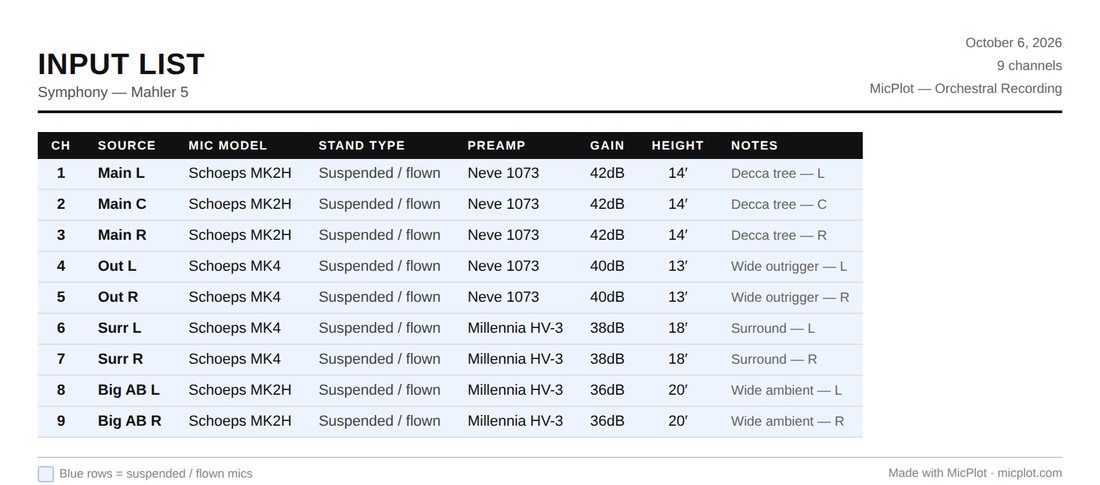
Tree, outriggers, spots and room pairs, each with model, stand, height, preamp and gain. Duplicate a mic and its L/R twin mirrors across the centre line.
Print the paperwork
A dimensioned mic plot, channel list, input list and stage plot, to PDF or straight to the printer.

Printouts your crew can rig from
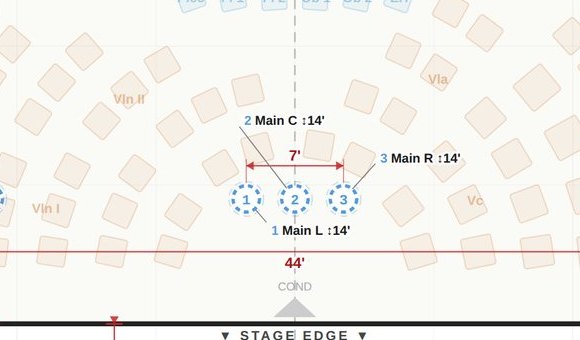
Every distance is measured from the centre line and the stage edge, in feet and inches or metres. Pairs, spacing and heights are called out, so nobody has to guess from a sketch.
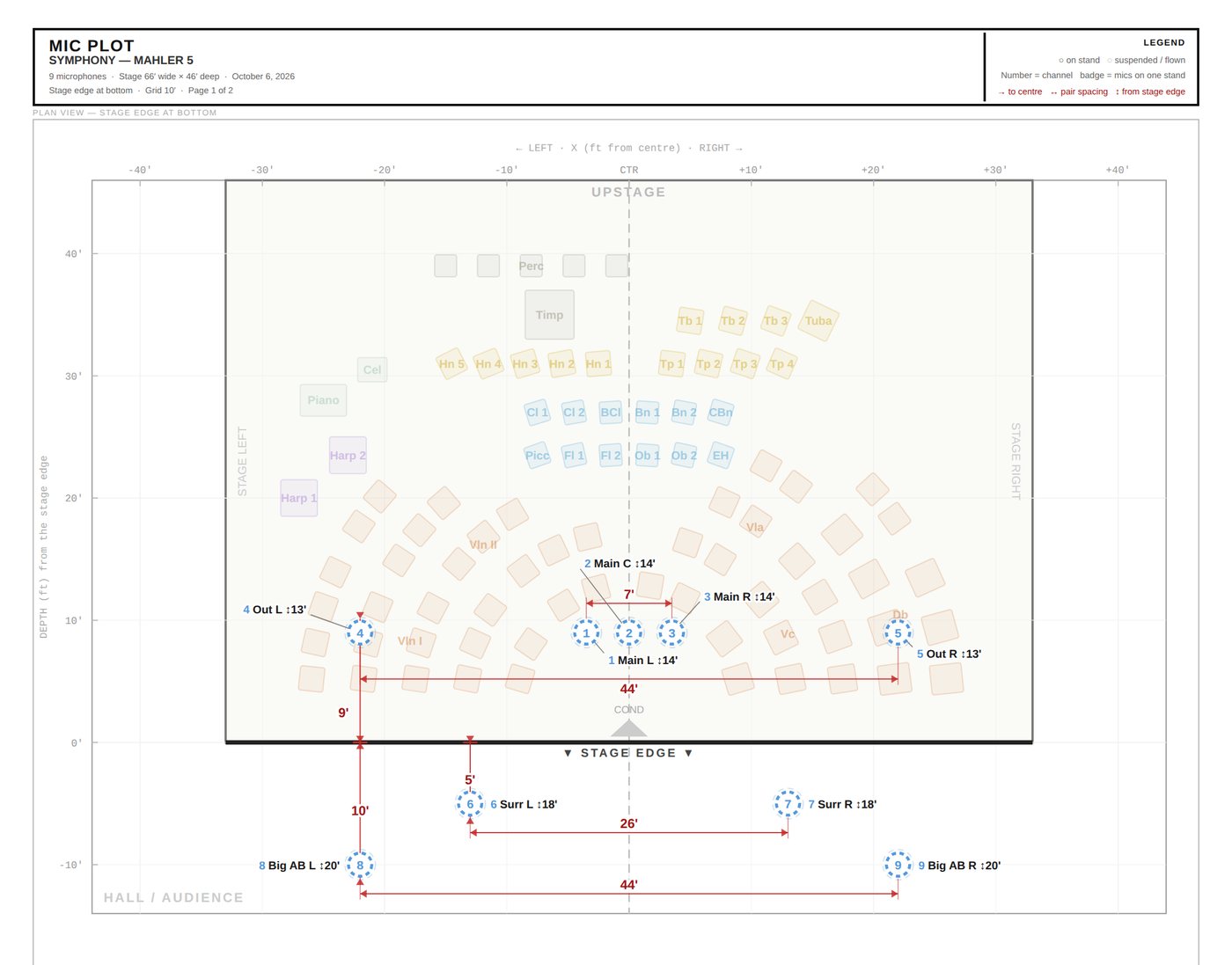
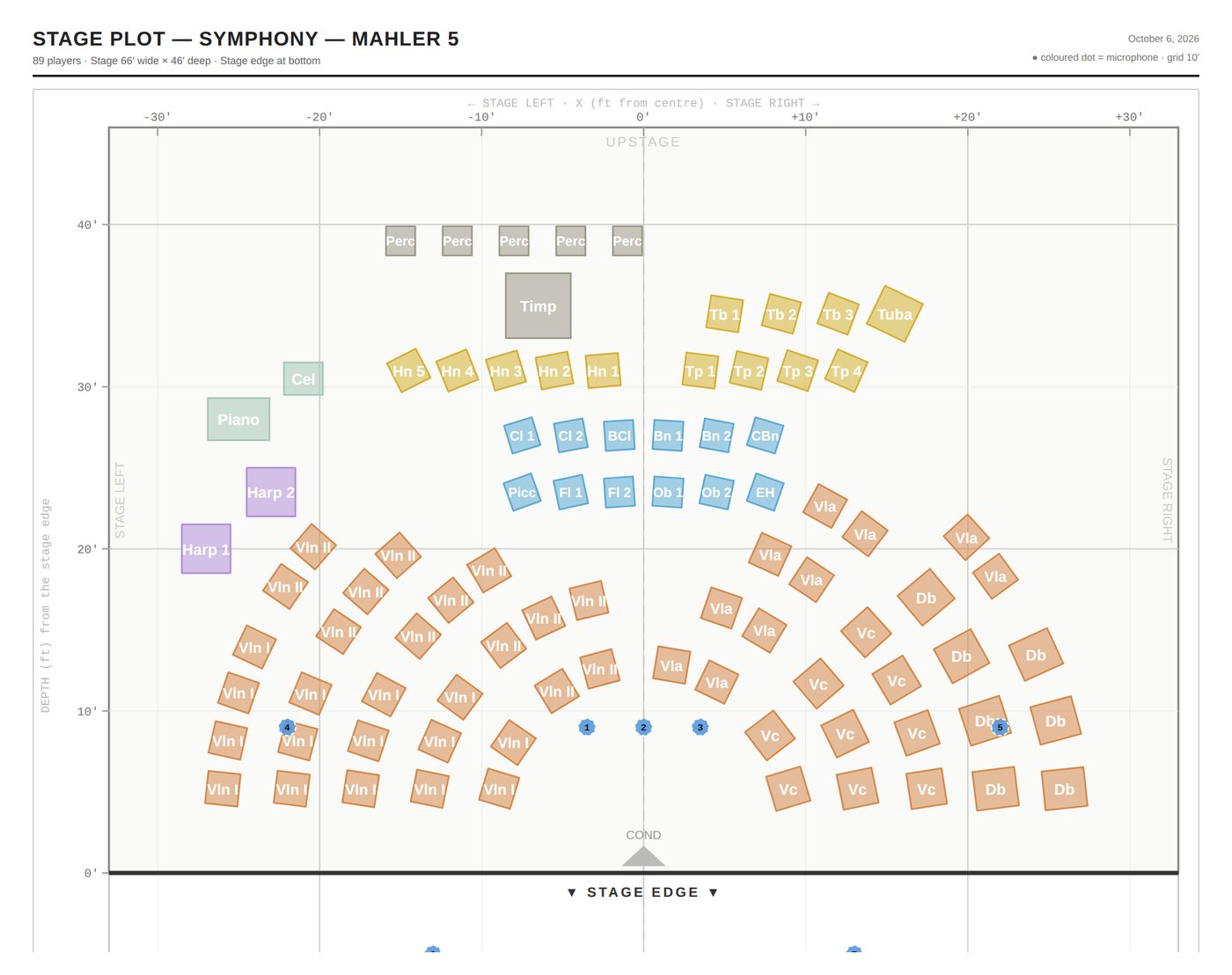
Distances you can measureLeft or right of centre and upstage or downstage of the stage edge, the way a crew paces it out.
Studio or concert hallA studio floor with a front line, or a hall stage with the audience in front. The wording on the prints follows the room.
Feet or metresSwitch units any time; plots and lists follow.
Start from what you already have
Drop in a photo of last season's rig, a hand-drawn plot or the orchestra's input list. AI import reads the microphones, positions and heights and builds a session you can check and adjust.
- Stage photos and video frames
- Input lists and mic plots as PDF, scan or phone photo, iPhone HEIC included
- Hand-drawn sketches on the back of a setlist
- An input list in Excel, Numbers or Google Sheets: paste the rows or open the .csv. That one needs no AI, so it's free and works offline
It reads positions and heights well from a clear photo or a typed list; expect to nudge a few mics before you print. Every free device gets a couple of imports a month to try it, and Pro has about 100.
Try AI import free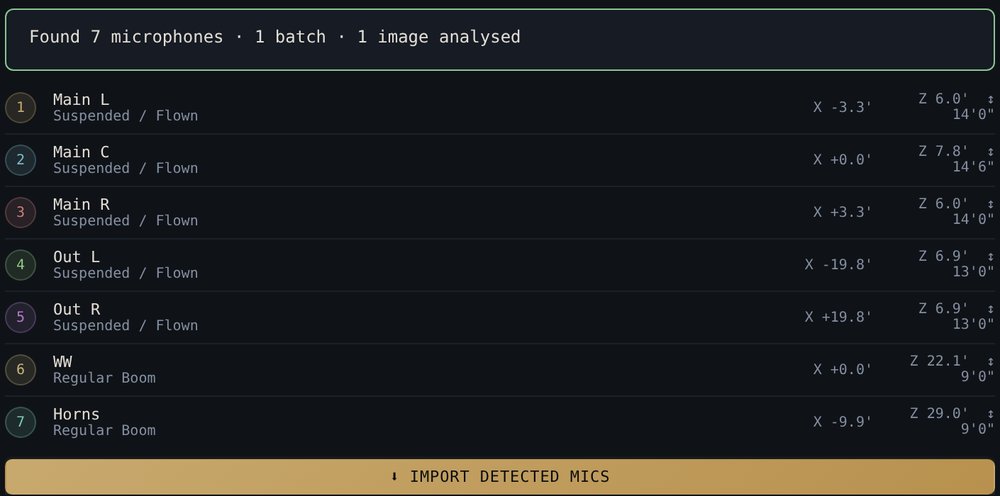
Works backstage, offline
Once it's loaded, MicPlot runs with no signal. Install it to your dock or home screen and it opens like any other app.
Your sessions stay yours
Sessions are saved on your device, with earlier versions kept as you work so a bad edit is never final. Export a JSON backup, or a single HTML file that opens straight back into the session.
Nothing leaves the device unless you ask
There are no accounts and no tracking of your sessions. Only the images you choose for AI import are sent, when you press Analyse.
Mac, Windows, iPad, iPhone, Android
Any current browser. A laptop or tablet is best for building a plot; a phone is fine for checking one on the gig.
Send the crew a link
Save → Share link gives a view-only link that opens the plot on any phone or laptop, with nothing to install. The plot travels inside the link; nothing is uploaded.
Catches mistakes before you print
Two mics on the same channel? MicPlot stops the print and shows you which ones, so the patch sheet and the stage agree.
Get the app
Open MicPlot in its own window from your Dock, Start menu or Home Screen. It works offline from the first launch, and your browser works just as well.
Prefer a Mac installer? Download MicPlot.dmg (macOS 12 or later, Apple silicon and Intel). It isn't signed by Apple yet, so the first launch takes one extra step: open it once (macOS says it can't verify it — click Done), then System Settings → Privacy & Security → scroll down to Open Anyway, and open it again.
Plot for free. Pay for AI import.
Everything you need to build and print a session is free. Pro is for engineers who import setups from photos and documents every week.
Free
$0
No account, no time limit
- 3D stage, seating templates, risers and gobos
- Unlimited mics and sessions
- Mic plot, channel list, input list and stage plot prints
- Works offline and installs as an app
- A couple of AI imports a month to try it (8 units)
Pro
$12 a month
or $99 a year, which saves 31%. Free for the first 7 days.
- Everything in Free
- About 100 AI imports a month (400 units)
- Up to 3 of your devices, linked with a code, still no account
- Your company name and logo on every printout, in place of the "Made with MicPlot" line
- Cancel any time and keep everything: plotting and printing stay free
Card required. Cancel before day 7 and you pay nothing. Refund within 14 days of any payment.
Teaching or studying recording? Send a message from your school address and you'll get 40% off Pro. Prices in US dollars; sales tax or VAT is added at checkout where it applies.
Questions
Do I need an account?
No. Open MicPlot and start plotting. Your sessions are saved in your browser on that device, and you can export them as files. Pro is tied to the device you buy it on, and you can add it to up to 3 devices with a short link code from Settings.
What counts as an AI import unit?
Each AI request costs one unit, plus one for every image or document it includes. Importing an input list and a mic plot together uses about 4 units; a batch of six stage photos uses about 7. Free devices get 8 units a month and Pro gets 400, shared across the devices you put it on. The pricier models count more: Opus 2–3×, Fable 5×; Sonnet, the default, counts 1×. Allowances reset on the first of the month.
Does it work without internet?
Yes. After the first visit, everything except AI import works offline. Install it from the browser (the Install app link in the footer of the app walks you through it) and it opens like a normal app.
Where do my sessions and photos go?
Sessions never leave your device. When you use AI import, only the photos or documents you added are sent, through MicPlot's relay, to Anthropic's Claude for analysis; they aren't stored by MicPlot. The privacy policy has the details.
Can I use my own Anthropic API key instead?
Yes. In Settings you can switch AI import to your own key, which is billed by Anthropic and sent straight from your device. Plotting stays free either way.
How do I cancel or get a refund?
Pro starts with a 7-day free trial; cancel before it ends and you pay nothing. After that, cancel any time from the link in your receipt email or in Settings, and keep Pro until the end of the period you paid for. Ask within 14 days of a payment for a full refund. Payments are handled by Paddle.com, our reseller. See the refund policy.
How accurate is AI import?
It reads mic positions, heights, stands and channel numbers well from a clear stage photo or a typed input list. Hand-drawn plots and dark or distant photos need more correction. Treat it as a fast first draft: check every mic before the plot goes to the crew.
Is my material used to train AI?
No. Photos and documents are processed by Anthropic's API, whose inputs aren't used to train their models by default, and MicPlot doesn't store them. Details are in the privacy policy.
What happens to my sessions if I cancel Pro?
Nothing. Your sessions stay on your devices, and plotting, printing and saving stay free. You only lose the larger AI import allowance and the clean prints.
Who makes MicPlot?
Brian Losch, a Grammy-winning orchestral recording engineer, through his company Losch Recording, LLC. He built it for his own sessions. Questions and requests go straight to him through the contact form.
Is it only for orchestras?
It's built around orchestral seating and classical mic technique, but any acoustic ensemble works: choirs, chamber groups, big bands and film scoring sessions. Live and broadcast engineers can use the same plots for their own planning.